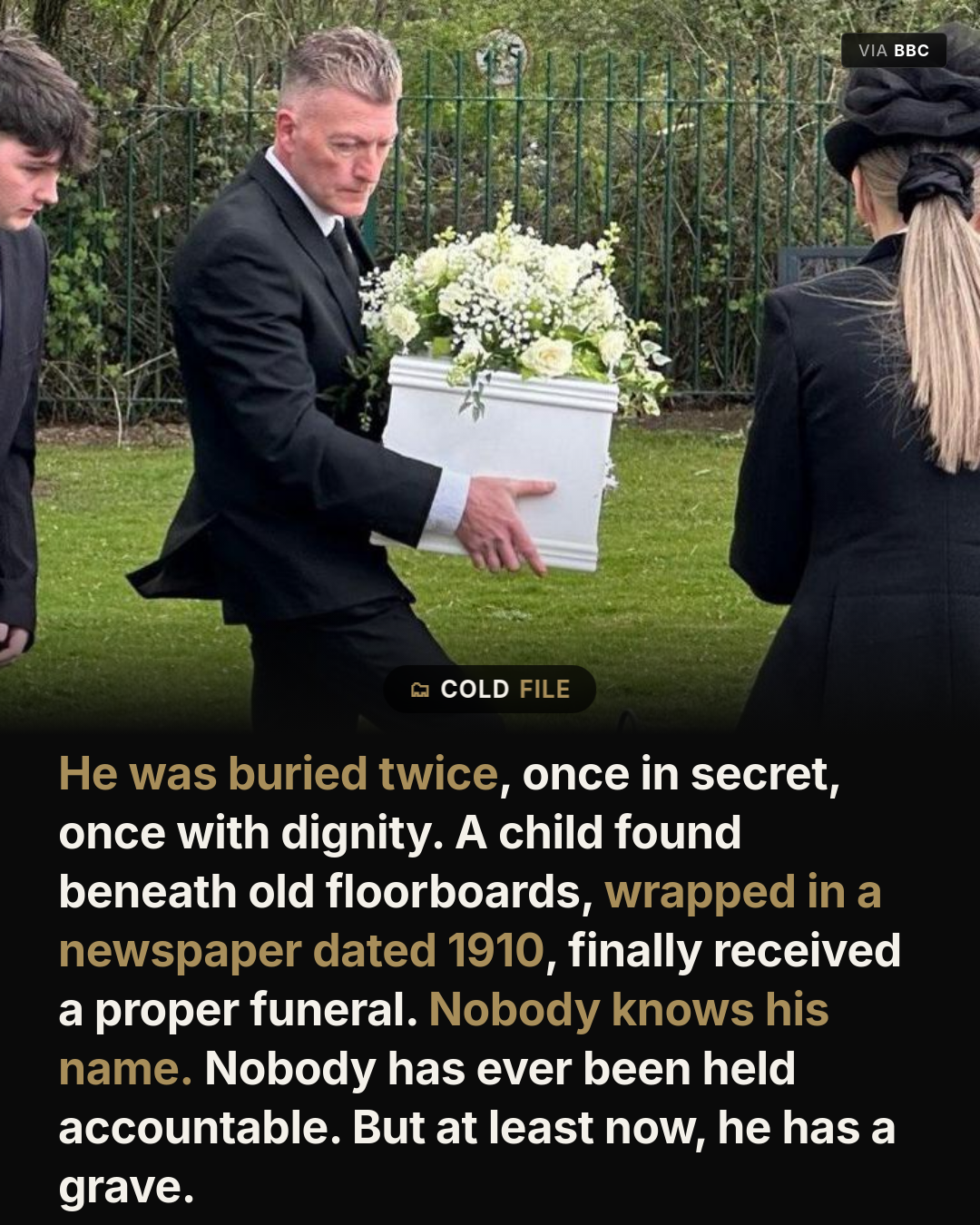
He was found the way secrets usually are, by accident, during renovation work, when the past refuses to stay buried.
The remains of a young boy were discovered beneath the floorboards of an old property, his small body wrapped in pages of a newspaper dated 1910. Beyond that, almost nothing is known. Not his name. Not his parents. Not what happened to him, or why someone chose concealment over a proper burial.
Forensic analysis confirmed the child was an infant or toddler, and that the newspaper used to wrap him dated to the early twentieth century, placing his death somewhere in that era, though an exact year has not been established. The condition of the remains made a full forensic picture difficult.
What followed, after the discovery, was a quiet but meaningful act: local authorities and community volunteers arranged a funeral. He was given a named headstone, a placeholder name, chosen with care, and buried in a local cemetery with a small ceremony attended by strangers who felt the weight of what had been lost.
Cases like this sit at a strange intersection of history, grief, and criminal investigation. A child hidden beneath a floor in 1910 could represent many things: a family in crisis, a concealed pregnancy in an era when that carried devastating consequences, or something far darker. Investigators have not publicly ruled anything in or out, and with no living witnesses and limited physical evidence, the likelihood of a definitive answer is slim.
What remains is a grave, a headstone, and an open question that may never close.
Some cases aren't solved. They're simply acknowledged. Does that feel like enough to you?